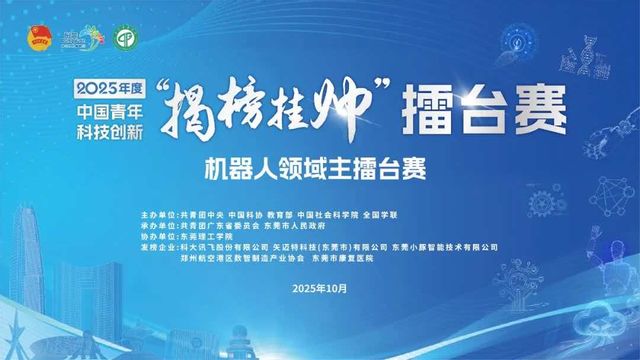
The 2025 China Youth Science and Technology Innovation "Launching Projects through Open Bidding" Challenge, Final Competition in the Robotics Field, was held in Dongguan, Guangdong Province from October 10 to 12.
Centering on core technological areas including intelligent perception, autonomous control and human-machine collaboration, the main robotics competition aims to unleash the innovative potential of young people and tackle key bottleneck technologies; deepen the integration of industry, academia and research to accelerate the application and commercialization of technologies; serve regional strategic development and empower the digital transformation of cities.
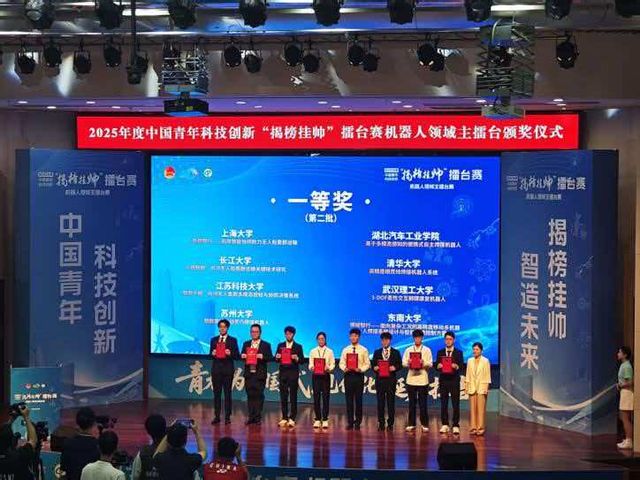
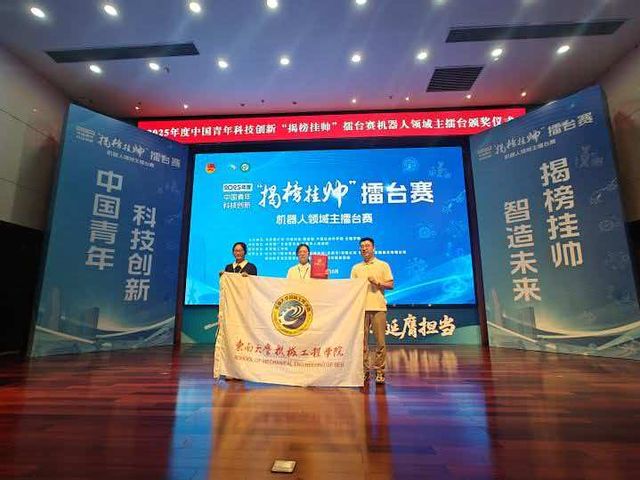
The "WeldDomain Smart Mobility" team from the School of Mechanical Engineering, Southeast University stood out in the competition and won the National First Prize.
With rigorous and practical innovation, they responded to real industrial demands, demonstrating the mission and responsibility of the college's young students in tackling key "bottleneck" technologies.
Project Introduction
Project Name: WeldDomain Smart Mobility – Design and Intelligent Scheduling Control Scheme for High-Precision Mobile Multi-Robot Welding Systems Under Complex Working Conditions
Team Members: Zhang Mengxin, Zhou Leshui, Hong Haowei, Fang Junwei, Xia Zhuoyang, Yang Qingyan, Cao Zhanning, Chen Zixin, Zhang Jiaming, Liu Baiheng
Advisors: Li Yongzhe, Wang Xiaoyu, Liu Xiaochao
Project Abstract
Practical engineering scenarios are plagued by four major pain points: diverse weld types, difficult process planning, strong multi-source disturbances, and limited detection methods. These issues result in weak collaboration, poor system flexibility, and low manufacturing accuracy.
Against this background, this project takes the welding and assembly of large-scale bridge steel box girders as its application scenario. Guided by the concepts of flexible autonomy, human-robot integration, and swarm intelligence collaboration, the team developed a high-precision multi-process mobile welding robot. Six core components were designed, including a self-leveling hydraulic support for the mobile chassis, a high-precision wire feeding mechanism, and a self-diagnostic welding torch nozzle with waste heat energy utilization.
The project has achieved breakthroughs in five key technologies:
Motion control of steerable flexible welding torch robots
Experience transfer and collaborative control from arc welding master technicians
Multi-source fusion sensing and defect recognition in welding processes
Calibration and stress control for multi-manipulator collaborative operation
Digital-intelligent operation and maintenance of multi-process mobile welding robots
Practical verification has been conducted on the prototype system. To date, the team has been granted 7 invention patents and 7 published invention patents.
In the future, the team will continue to focus on the development of intelligent welding equipment, accelerating the progress of domestic welding robots from "following" to "leading".
Contributed by | Wang Yunfeng
Typeset by | Zhu Yan
Reviewed by | Peng Long

